
Point Shooting: Understanding the Skill, the Myths, and the Reality


When most people think about defensive handgun shooting, they picture carefully aligning sights, controlling breathing, and squeezing the trigger with precision. While those skills are critically important, real-world defensive encounters often unfold very differently.
Most violent encounters happen suddenly, at close range, and under intense stress. In those moments, the body reacts instinctively. Heart rate spikes, vision narrows, and fine motor skills deteriorate. Many shooters naturally focus on the threat rather than their sights.
This is where point shooting becomes part of the conversation.
Point shooting has been debated for decades in military, law enforcement, and civilian self-defense circles. Some view it as an essential defensive skill. Others believe sighted fire should always be used whenever possible. The reality is more practical: point shooting is a tool — not a replacement for marksmanship fundamentals.
With our backgrounds in law enforcement, we have trained extensively in utilizing point shooting when necessary. It can be a very effective tool when used in the proper situations.
Understanding how and when point shooting applies can make you a more capable and realistic defensive shooter.
The Old West
When you picture gunfighters in the old west facing off for a duel – although highly dramatized and enhanced by Hollywood – the scenes that we are familiar with do not depict shooters obtaining a good sight picture. They were down and dirty. The first person firing from the hip or point shooting to get rounds on target quickly had the biggest advantage.
Remember the shootout at the O.K. Corral in Tombstone, Arizona? This shooting has been portrayed in multiple movies throughout the years. The shooting actually occurred in a small narrow lot within a few feet of each other.
Black powder smoke, poor sights, and extremely close range made point shooting the logical tactic in those situations.
What Is Point Shooting?
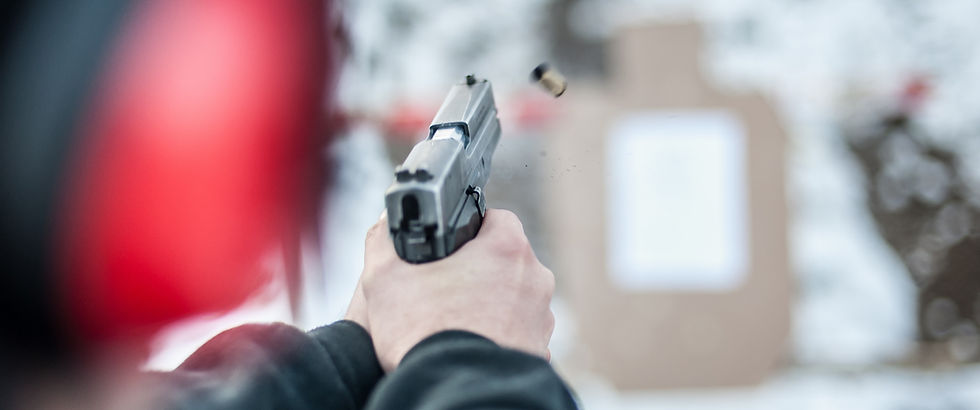
Point shooting is the act of aiming a firearm primarily through body alignment, natural indexing, and muscle memory rather than deliberate sight alignment.
Instead of shifting visual focus to the front sight, the shooter remains focused on the target while presenting the handgun naturally toward the threat.
Point shooting is most commonly associated with:
Close-range defensive encounters
Rapid reaction situations
High-stress environments
Retention shooting positions
Defensive handgun training
At extremely close distances, there may not be enough time to achieve perfect sight alignment before action is required.
Why Point Shooting Exists
Human performance changes dramatically during stressful encounters.
During a lethal-force event, the body experiences physiological reactions commonly known as the “fight-or-flight” response. These reactions can include:
Tunnel vision
Increased heart rate
Auditory exclusion
Reduced fine motor skills
Visual fixation on the threat
Slow motion
Under stress, many individuals instinctively focus on the source of danger rather than the firearm’s sights. Because of this, we often see firearms getting hit with rounds during an exchange of gunfire.
Point shooting developed as a method that works with these natural reactions instead of fighting against them.
The History of Point Shooting
Point shooting is not a new concept.
Military and law enforcement instructors have taught variations of instinctive shooting for generations. During World War II and beyond, many close-combat programs emphasized rapid target-focused shooting techniques for close-range engagements.
Over time, firearms training evolved as handgun sights improved, optics became more common, and studies of defensive shootings expanded. Today, many instructors teach a balanced approach that combines both point shooting and sighted fire depending on distance and circumstances.
Advantages of Point Shooting
Faster Engagement at Close Range
At distances of only a few feet, speed may become more important than perfect sight alignment.
Point shooting can allow a shooter to:
Respond more quickly
Engage threats faster
Reduce reaction time during sudden attacks
In close defensive encounters, fractions of a second matter.
Maintains Visual Focus on the Threat
One major advantage of point shooting is maintaining focus on the threat itself.
This may help the shooter observe:
The suspect’s hands
Additional threats
Movement
Weapons
Environmental hazards
Threat-focused shooting may improve situational awareness during rapidly changing encounters.
Useful in Retention Shooting
At extremely close distances, fully extending the handgun may not be possible or safe. An attacker may attempt to grab the firearm or overpower the defender.
Picture yourself in a situation where an armed suspect has knocked you to the ground and is on top of you. How about an armed encounter where you are in direct contact with the suspect possibly struggling over a weapon.
Point shooting principles are often integrated into:
Close retention shooting
Compressed shooting positions
Weapon retention techniques
These skills are especially valuable for defensive carry and law enforcement applications.
Limitations of Point Shooting
Accuracy Decreases with Distance
As distance increases, point shooting becomes less reliable.
Small alignment errors at close range become much larger misses at greater distances. Beyond a certain point, sighted fire becomes necessary for responsible accuracy.
This is especially important because every defensive shooter is accountable for every round fired.
Requires Extensive Practice
Effective point shooting is not random shooting.
Do you train at extremely close distances such as 0 to 3 yards? If not, you should consider it as many shooting situations are up close and personal.
We incorporate close distance and point-blank shooting into our trainings as most civilian shooting encounters occur within 7 yards. The majority of which are well under the 7-yard mark.
Proper point shooting requires:
Consistent draw stroke
Repeatable presentation
Proper grip
Body alignment
Repetition under realistic conditions
Without training, shooters often overestimate their ability to hit accurately under stress.
Be cognizant of your support hand while training and implementing this technique. In our firearms classes we often introduce this tactic by having the support hand grasp the collar of the shooter’s shirt during one handed shooting from the hip scenarios, to prevent accidental injuries.
Initial implementation with an empty firearm is always advised.
Anything beyond point-blank range the shooters will incorporate their normal two-handed grip.
Can Encourage Bad Habits
Some shooters incorrectly assume point shooting eliminates the need for sights altogether.
This can create dangerous habits, especially when:
Distance increases
Precision shots are needed
Innocent bystanders are nearby
Lighting conditions worsen
A complete defensive shooter should be capable of both instinctive shooting and precise sighted fire.
Point Shooting vs. Sighted Fire
The debate between point shooting and sighted fire often creates unnecessary division.
The reality is that both methods have value.
Many experienced instructors teach a blended approach:
Extremely close range = more threat-focused shooting
Intermediate range = flash sight picture – front sight
Longer range = deliberate sight alignment
Distance, time, environment, and threat level all influence which technique becomes appropriate.
Good shooters adapt to the situation rather than relying on a single method.
When Should You Transition to Sights?
A common question in defensive shooting is: “At what distance should I stop point shooting and start using my sights?”
The answer varies based on:
Skill level
Training
Lighting conditions
Target size
Stress level
Environment
For many shooters:
Very close distances may rely heavily on body index and target focus
Around 5–7 yards, sights become increasingly important
Beyond that distance, deliberate sight use often becomes critical
The key is understanding your own abilities through realistic practice.
The Importance of Realistic Training
Point shooting cannot be mastered by standing still on a square range.
Developing practical defensive skills requires:
Drawing from concealment
Movement drills
Stress-based exercises
Decision-making scenarios
Close-range live fire
Low-light training
Realistic practice helps shooters discover what actually works under pressure.
While using our video scenario simulator we have found that many shooters can be very accurate and quickly put rounds on target while utilizing point shooting. Scenario simulators can effectively enhance your skills and confidence.
Common Misconceptions About Point Shooting
“Point Shooting Means Spraying Bullets” = False.
Proper point shooting still emphasizes controlled, accountable fire and disciplined trigger control.
“You Never Need Sights” = False.
Sights remain extremely important for precision, accountability, and longer-distance engagements.
“Point Shooting Is Easier” = Not necessarily.
While close-range target-focused shooting may feel natural, becoming consistently accurate still requires repetition and discipline.
Final Thoughts
Point shooting is simply one tool within a complete defensive shooting skill set.
Real-world encounters are unpredictable. Distances vary. Lighting changes. Stress affects performance. Responsible defensive shooters should understand how to adapt to those realities while maintaining safety, accuracy, and accountability.
The goal is not to abandon sights and to use them when needed.
You should work to develop the ability to respond effectively under pressure while using the appropriate technique for the situation at hand.
At E1 Tactical Solutions, we teach practical defensive handgun skills based on realistic encounters, helping shooters develop confidence, situational awareness, and effective response capabilities through structured, experience-driven firearms training.

Comments